By Admin
In healthcare facilities, infection prevention is often associated with clinical practices, but building systems play a critical role in maintaining safe conditions. Airflow, humidity, pressure balance, and system reliability all influence how well a space performs. When these elements are stable, they help create environments that support patient care and limit the conditions where contaminants can persist.
Healthcare buildings operate under precise environmental requirements. Different areas, from patient rooms to specialized treatment spaces, depend on controlled air and moisture levels to function properly. Even small inconsistencies can affect how these spaces perform. Over time, issues may develop gradually. Systems may still be operating, but declining efficiency, inaccurate sensor readings, or drifting controls can begin to impact overall conditions.
Why Consistency Matters
Environmental control is most effective when it is consistent. In healthcare settings, steady system performance helps maintain the conditions needed for both patient care and operational reliability. When cooling systems, airflow distribution, and control systems are working in alignment, facilities are better able to maintain stable indoor environments across different zones.
Component performance plays a significant role in this stability. Coils, valves, sensors, and drainage systems all contribute to how effectively air and moisture are managed. When these components begin to degrade, the effects can spread throughout the system. Reduced heat transfer, uneven airflow, and inconsistent control responses can make it more difficult to maintain the intended conditions.
Planning for Performance Over Time
Long-term environmental control depends on both system design and ongoing upkeep. Equipment must be selected with the demands of healthcare environments in mind and maintained to ensure consistent performance. As systems age, proactive maintenance and replacement planning become essential to avoid disruptions.
Restoring system performance often means addressing the underlying components that affect efficiency and control. By maintaining these systems, facilities can better manage temperature, humidity, and airflow across the building.
Integrating Infrastructure Into Prevention
Environmental control should be viewed as part of a broader approach to infection prevention. Reliable mechanical systems, routine maintenance, and forward-looking planning all contribute to safer healthcare environments.
By focusing on system consistency and long-term performance, healthcare facilities can better support daily operations while maintaining the conditions needed for effective care.
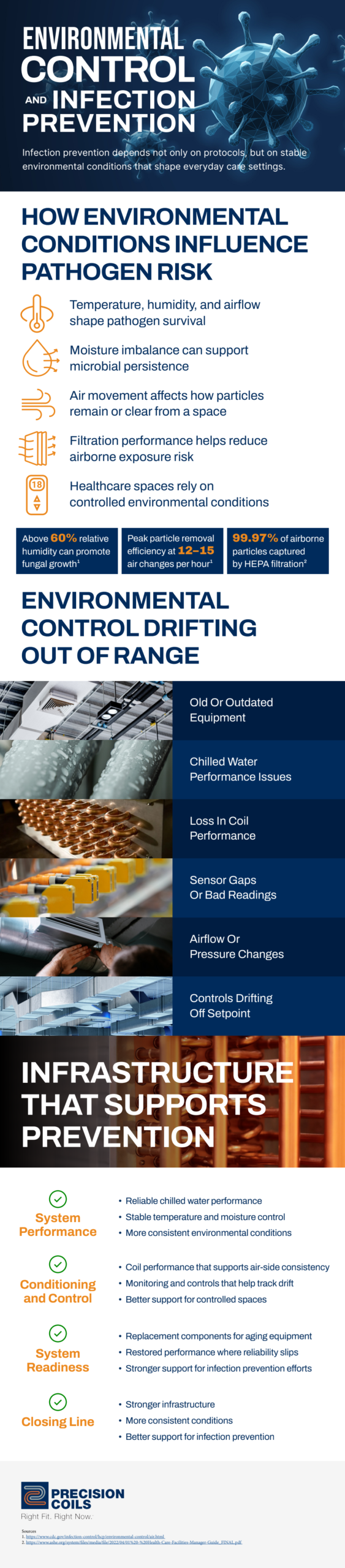
For a visual companion to this topic, explore the accompanying resource on environmental control and infection prevention from condenser coil manufacturer, Precision Coils.