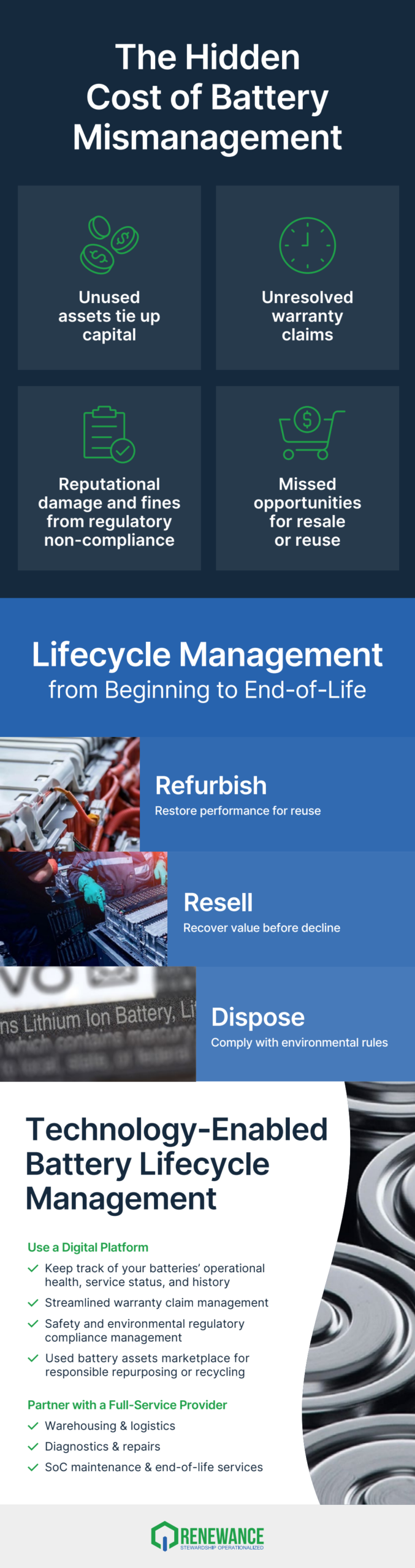

As industrial batteries become more widely used across industries such as logistics, construction, warehousing, and data infrastructure, managing them effectively has become more complex. While performance and recycling often receive the most attention, a critical gap exists in between these stages. Improper storage and lack of oversight can lead to batteries being forgotten, degraded, or discarded prematurely, creating both financial loss and environmental impact.
How Batteries Fall Out of Sight
The disconnect often begins as soon as batteries enter a facility. They are frequently purchased in bulk and stored for future use, but without proper tracking systems in place. Unlike other high-value assets, batteries are often treated as passive inventory rather than time-sensitive components that require monitoring.
Over time, stored batteries can lose charge, degrade, or become unsafe if not maintained properly. What starts as backup inventory can turn into unused or unverified stock. In many cases, these batteries are removed from service not because they are unusable, but because their condition is unknown. This type of loss is common in operations that lack structured battery management or clear accountability for maintenance and tracking.
The challenge becomes greater when batteries are moved between locations. Without consistent documentation, key details such as charge levels, usage history, or prior deployment may be missing. Faced with uncertainty, facility managers may choose to dispose of or recycle batteries as a precaution, even when they still have usable life remaining.
Turning Visibility Into Value
Improving battery lifecycle management does not require a complete overhaul of operations. The first step is increasing visibility. Implementing tracking systems, whether through barcoding or digital platforms, allows organizations to monitor each battery from arrival through its lifecycle.
Routine checks, including charge monitoring and condition assessments, help identify issues early and prevent unnecessary loss. Training teams to manage batteries proactively ensures that they remain in use for as long as safely possible. Most importantly, shifting the mindset from treating batteries as consumables to managing them as assets creates a more structured and accountable approach.
By improving storage practices and tracking, businesses can reduce waste, recover value, and support sustainability efforts. A more proactive approach to battery management strengthens operational efficiency while aligning with broader environmental goals.